 A word on AI-generated content.
When The Rains Come
This originally appeared as part of a past Reader's Room newsletter. Sign up if you'd like more things like this, as well as weekly reading recommendations.
If you set (part of) a novel in Singapore and you have the slightest concern with being realistic, you will think about rain. It rains one day out of every two there. And where there is rain and people, there will be umbrellas. For most of my life, I considered umbrellas to be temperamental devices that sulked in the back of closets. When they did see the (dreary) light of day, they were just barely worth the trouble.
Then I lived in Tokyo, where it rains one day in every three, on average. Everyone walks, so everyone spends some time under the sky. In Tokyo, umbrellas are more than a necessary accessory, they were a part of the culture. People form relationships with umbrellas, there was a whole infrastructure to support the umbrella-carrying lifestyle. Many business entrances had what I thought of as "umbrella condom machines": Little kiosks that would, with one smooth motion, sheathe your wet umbrella safely in a plastic bag. (I've only ever seen one of these in the US and no one used it because one knew what it was or how it worked. Here's a short video for the curious.) Fancy stores might have a uniformed and gloved person to bag your umbrella for you. (Or, if the store ran out of bags for their machines, an employee might manually recycles the bags, removing them from departing customer's umbrellas, and applying them for an incoming customer.) Convenience stores lived up to their name with big umbrella stands near the door, for parking umbrellas for a damp minute. (Outright umbrella theft was rare, but sometimes people would accidentally grab a similar umbrella from the communal stand. It was sort of a "leave an umbrella, take an umbrella" system.) A few places had self-service umbrella lock-ups. My favorite bar would valet them, taking then when you entered, parking them in the back room, and returning them to you when you left. (And, if it started raining while you were there and you hadn't thought to bring an umbrella, they might give you one from their lost-and-found.) My time in Tokyo dramatically expanded my life experience with umbrellas.

Fancy, multiply-collapsible, highly compact umbrellas were relatively rare. Almost everyone carried a traditional full-length one. The infrastructure was built around them. Compact ones don't work in the wrap machines, and they end up at the bottom of a damp pile in the umbrella stands.
If you damaged your umbrella, you could go to the craft store and buy spare parts. Under the train tracks in Shinjuku, a man collected discarded, broken umbrellas, fixed them, and resold them to pedestrians. Parasols were also common, but distinct from umbrellas. They're not water proof, and often made of lace.
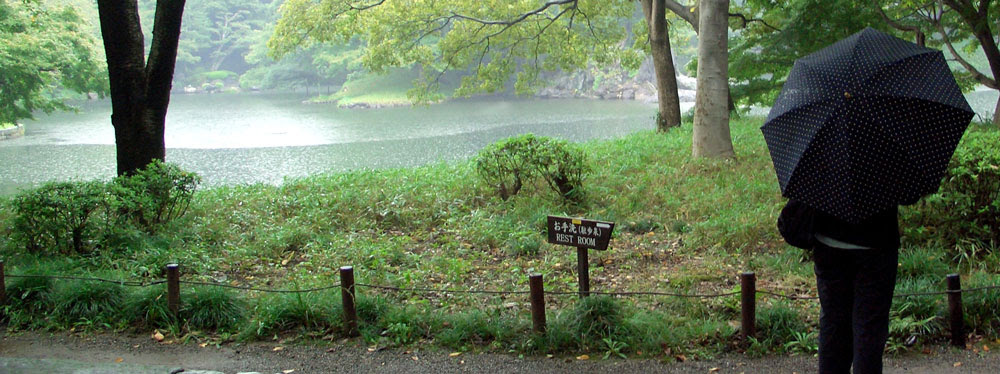
I was returning to the US on a rainy day, and had some time to kill after checking out of my place, so I stopped at Mos Burger* (a Japanese fast food chain) to grab a bite before boarding my train to the airport. I carried an umbrella that I scavenged from the recycle room in my apartment-hotel. The staff would separate out the lightly used left-behind umbrellas and stack them in a corner for scavengers like me, but I had forgotten to leave it when I set out that morning. The rain had stopped and I didn't want to bring a full-length umbrella on the airplane. I wouldn't need it on the train to the airport. (I always worried about poking people with them.) So I decided to leave it behind at the Mos Burger. The mechanisms in place would find it to a good home.
I set out to the nearby train station, guiding my suitcase through the sparse sidewalk traffic, burdened by the rhythmic sound of its wheels on the brick sidewalk, but lighter by one umbrella. Halfway to the station, I heard quick footsteps behind, and the voice of a woman: "Sumimasen—Ekusukyusu mi!" she called. (That is "Excuse me" in Japanese and heavily accented English). I was the only obvious native English speaker on the street, so I stopped and turned. A young woman was running to catch up. She wore a forest green uniform with a short, wide tie, and a jaunty beret with a little Mos burger pin in the front. In one fist was clutched my umbrella. She stopped in front of me, just slightly out of breath, smiling and eyes bright for having caught me in time. "I have your umbrella," she said in Japanese, giving a little bow and presenting it to me with both hands. Not, "You forgot it." There was no blame. Just, "I have it."
What could I do? The umbrella had followed the mechanisms in place, and found a home. I took it back, also with both hands. I thanked her as we exchanged bows. We went our separate ways. Her to the shop up the block, me to a country an ocean away, where umbrellas sulked, unappreciated, in the backs of our closets.
* The great thing about Mos Burger was that if you ordered french fries, they always snuck an onion ring in, like it had just slipped in by accident. If you ordered the rings, a few fries would sneak in. Every time.
The Fading Voices From The Moon
"I have done things and been places you simply would not believe, and I keep that inside of me." — Mike Collins, Apollo 11 Command Module Pilot.
"…Most people just look at [the moon] as something flat out there in the night sky. But I look at it as a sphere. I can feel the depth of it. I know that it's in inner space. I mean, I know that it's not at the end of that blackness." — Gene Cernan, Apollo 17 Commander.
Cernan passed away a week ago Monday. He was the last human to walk on the moon and spent more time walking its surface than anyone. (His crewmate, geologist Jack Schmitt, missed out my just a few minutes.) There are only six people with living memory of walking on on the surface of another world, and the youngest is 81. The Apollo program was a remarkable achievement, certainly worthy of the many books written about it, the people in it, both famous and hidden figures. But it's the words of the participants themselves that have always grabbed me.
Moonwalkers share the rarest and most remarkable experiences. Reading quotes from before and after their trip, it's clear it changed them. Few of them were known for (appropriately) expressing themselves before their journey. Ken Mattingly, Apollo 16 Command Module Pilot, once said, "Money should have been spent to find […] a Hemingway that can capture the feeling and describe, to say, 'I saw this. And I saw that. And I saw this.' That would have been worth the price of Apollo."
And yet many of them became poets on the trip there and back. (For variety, Apollo 12 CMP, Alan Bean became a painter of some note.)
Voices From The Moon is a hardbound collection of stories, quotes, and photos by those who went there. Edited by Apollo scholar Andrew Chakin, it lets the astronauts tell their own stories in their own words, from pre-Apollo Right Stuff-era all the way through the end of the program and its impact today. It's as much (or more) a photo book as a story collection, each page containing excellent reproductions of the most stunning restored photos from the Apollo archive. There is no e-book version, which is for the better. It's best seen and experienced in its physical form. (Much like the moon.) Published in 2009, it's not a brand new book. Then again it's not a new story. The only chapters being written in crewed moon exploration are obituaries.
Maybe my fascination with Apollo is just me romanticising a time I never knew. Cernan, Evans, and Schmitt's journey on Apollo 17 was the only one to happen in my lifetime, and I was just a few weeks old. I didn't get to see the people of Earth take crewed space travel from its first tentative steps all the way working driving to work on the moon in a short decade—not only training the astronauts, but the much larger task of building the machines and technology for them to do so.
But space travel is getting interesting again, both as an observer and commercially. We have had people living and working in space for sixteen continuous years, which is just as much of an accomplishment as Apollo, and couldn't have been done without it leading the way. So who knows what I might yet see humanity (and individual humans) achieve in my lifetime.
(A version of this originally appeared in a past issue of the Reader's Room. Subscribe to get it (and more good things) in a more timely manner.)
Talking It Out
“Hey Siri, add cinnamon to the grocery list,” I yelled from the kitchen.
Siri was sitting on the arm of the big sofa in the living room, not doing much of anything. “I’ve added it,” she called back a second later.
“Thank you!” I said, and continued making dinner.
She didn't say, “You’re welcome,” and I wasn’t cooking anything for her to eat. She’s just a bot that’s ported through my tablet. A thin physical front-end for a huge ad-hoc network of computers and a staggering amount amount of data, with meaty pattern recognition algorithms to glue them all together.
And yet I'd said, “Thank You.”
I can talk to Siri on my phone too, but she's more literally under my thumb. I’ve set it up so I have to hold a button for her to hear what I say. She doesn't talk back, but replies via text.
I never say “Thank you” to my phone. I say it to my tablet all the time.
Somewhere between my phone and my tablet is a line. On one side is a tool, like a spoon or a car. On the other is… a being—at least as far as my subconscious is concerned. It's something that I think is worthy of thanking for their work. I've never thanked my spoon or my car. Or even my tablet as a whole. I only thank it when we're having a helpful conversation, where I ask something, and it understands* and replies.
Everyone has this line, and everyone has it in a different place. Some people thank Google after typing every search, while others consider any digitally-mediated presence as less than human, even when they are all too human.
Virtual assistants are far from perfect—they're barely at the cusp of usefulness—but they’re moving tech into places it hasn’t been before, and its getting better quickly and transparently. Our virtual assistants are being called as witnesses in murders. (Kind of.) Or they're being asked to perform more intimate and domestic roles. (Yes, that link is SFW, but probably deserving of its own article. Or several dozen research papers.) These are the early days. Right now it's hard to predict all the ways we'll use vast supplies of hardware, data, and algorithms when they're wrapped inside something we treat like a person.
* Yes, it "understood" in these limited circumstances. It added cinnamon to my grocery list. It however doesn't know what cinnamon is or what a grocery list are for.
(A version of this was originally published in a past issue of the Reader's Room.)
Read: "Rebuilding" in Helen Literary Magazine

Helen Magazine teamed up with the Neon Museum to sponsor a bit of literary inspiration. The Neon Museum is one of my favorite places in Las Vegas, naturally full of untold stories. Thanks to the staff of both places, I was able to tell one of them. Rebuilding is more literary and less science fictiony than what you might be used to from me, but it's a nice short tale of two people building something new in the desert.
Read it now. (1300 words.)
Shards of Loyalty (Embassy Book 3) Is Now Available
The third book in the ongoing Embassy series is now available in paperback and Kindle ebook. An uncontacted extraterrestrial has just killed thousands, and the Embassy has decided that Acting Ambassador Benjamin Taylor is not the right person to meet this crisis. Even though the organization that he's given his life for has thrown him aside, allies and aliens conspire to keep him at the center of interplanetary events, sending him undercover and in over his head.
The paperback version is enrolled in Amazon's Matchbook program, which means when you buy the paperback you can get the ebook at a discount. At the moment that means free.
The fourth book, likely the last in this particular arc, is underway and progressing well. It should be available sometime in the summer of 2016. Click on "Updates" in the title bar to keep informed on its release.